
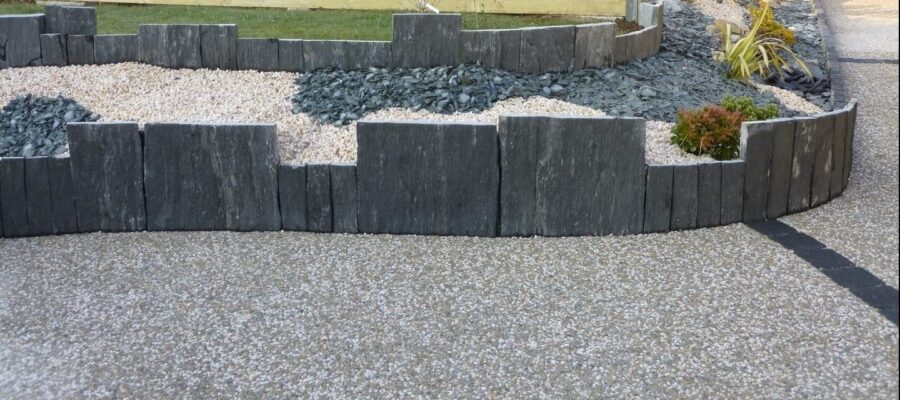
Have you heard of the deactivated concrete? Do you want to know more about this material? Biolooly explains its advantages and disadvantages to you.
What is deactivated concrete?
Apparent aggregates are an excellent alternative for customers who want a decorative finish at an economic cost. This is undoubtedly the most durable finish you can make on an entrance or a patio. The apparent aggregate is a popular choice of finished concrete that exposes or encourages pebbles or stone on the surface of the concrete to be shown. The finished aspect is that of a aggregate the size of a pebble in the whole concrete and the coloring is mainly derived from the color of the chosen aggregate. The deactivated concretes are washed concrete with a gravelly appearance which reveals the color of the gravel on the surface. From an aesthetic point of view, they can be used for unity surfaces and unusual material effects, thanks to their non -slip surfaces, robust and also very resistant to thermal shocks
 .
.
Advantages of deactivated concrete:
This type of coating is more aesthetic than a concrete slab. The different possibilities in the choice of aggregates and background colors open up new perspectives in terms of decoration
-
- Deactivated concrete is very easy to maintain;
-
- Wear resistance
-
- Thermal shock resistance;
-
- Surface uniformity;
-
- Quick implementation;
-
- Ease of adaptation to different forms;
-
- the sustainability of development over several decades;
-
- Simplified maintenance after spraying finishing resins.
Concrete deactivated: Application areas:
-
- Urban roads, pedestrian garden;
-
- Garage access, cycle path, …..;
-
- Roundabout, curb;
-
- Terrace, place, school courtyard.
Implementation: – Concrete to be deactivated will be implemented by average short -term vibration or by float; – Use synthetic fibers to improve concrete cohesion to deactivate and facilitate implementation. – wait for the bleeding water to disappear and then homogenize the product uniformly thanks to a spray system; – After 05 to 24 hours depending on climatic conditions, concrete is washed with pressure water.
Disadvantages of deactivated concrete
You can imagine, the deactivated concrete does not only have strengths:
-
- It has a fairly old -fashioned appearance, the grainy aspect even if it is economical is still very «80s», if you want to give value to your home, it is not the decorative concrete of outdoor that we recommend.
-
- It is solid in the face of bad weather and shocks, but despite everything in the event of a big accident it is much more difficult to resume than a classic concrete.
-
- If you ever want to develop your exterior, you will have to break everything and the site may be colossal
Our opinion: What alternatives to deactivated concrete then?
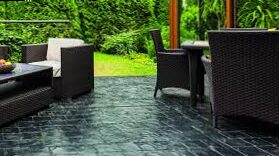
Biolooly strongly advises you the waxed concrete instead, which gives a lot more cachet to your exterior: it can apply as well to the terraces, as to the external furniture elements, to the alleys … Its cost is not much higher than a classic slab and its variants of finishes and chromies give it a richness of unrivaled aspects. Printed concrete is also an alternative solution but it has constraints similar to deactivated concrete. Do not hesitate to contact Biologement to get more information! Finally, here are some examples of construction sites made using waxed concrete for the outside.
How to make deactivated concrete?
Once the concrete is put in place, the decorative aggregate is ready to be revealed. There are several exposure methods, among which entrepreneurs can choose, depending on the desired aspect and the size of the project. Only the upper part of the stone is exposed, while the rest is definitively buried in concrete. The general rule is to remove the surface mortar on a depth not exceeding a third of the diameter of the aggregate particle.
Brushing and washing
It is the oldest and simplest method because it does not require chemical delay or special tools. Just wash the thin layer of surface mortar that covers the aggregates by spraying water and rubbing with a broom until the aggregates are exposed to the desired depth. The time of the operation is however critical, so that this method is often better suited to small work. The work must start as soon as the surface mortar can be removed without overexposing or dislodge the aggregate. You can test this by slightly brushing the surface mortar in a small area with a steep nylon hair broom.
Use of a surface delayer
Today, most entrepreneurs exhibit aggregates by spraying a chemical surface delay on the surface of the slab immediately after installation and finish. This delays the socket and gives them the possibility of removing the cement paste until a day or two later, either by rubbing or washing under pressure. This flexibility can be particularly important for major works or in hot weather.
Abrasive stripping
It is also possible to expose the aggregate after taking and hardening of concrete using an abrasive jet (either a sand jet or a jet of grenaille). The disadvantage of sandblasting is that it can fracture the aggregate and tarnish the appearance. This method is not a good option if the preservation of the shape and intensity of the color of the aggregate is essential.
What thickness for deactivated concrete?
The recommended minimum thickness is 2.5 to 5cm for a deactivated concrete coating placed on a basic slab practically exempt from cracks is healthy, clean and good.
What is the price of deactivated concrete?
The cost of deactivated concrete is very close to that of waxed concrete or washed concrete, from 40 €/m² and unclassing several hundred euros depending on the thickness and quality.
Concrete deactivated, what color?
Ask for help to choose the best colors from a local entrepreneur specializing in concrete aisles. It can often bring physical samples to your home or make simulations on site.
When you choose the color you want to use for your aisle, there are some ideas that you need to take into account to make this decision. Make a match with the color palette of your home – by completing the existing colors of your home, your alley will seem to be integrated naturally. Light colors reflect heat, dark colors absorb it – colors can have an impact on the ability of your surface to endure heat, and therefore on the possibility of walking barefoot on this surface. Make the color of the stamped pattern correspond – use the chosen pattern for stones or natural bricks to determine the colors that will give this motif a more realistic appearance.
Latest Posts Published

The assets of the ironwork style for your gate
What elements influence the price of fuel oil?

Yucca with drooping, yellow, dry, brown leaves at the end or that loses its leaves: what to do?
How to choose tiles that you will not tire

Debout, kitchen and dining table
The advantages of combined electricity and gas offers

When and how to plant an avocado in a pot: maintenance, watering, exposure, repotting
5 ideas for arranging the basement of a house

How to choose a floor wash robot
