
Two heads on the same cushion, one paw resting across the other’s back, and suddenly the moment looks like proof of friendship. It may well be. When relaxed dogs choose to make contact, it can reflect a familiar and comfortable relationship, but a photo never tells the whole story. What matters most is whether each dog still has freedom: can they move away easily, and do they do so without being followed, blocked, or pressured?
Some dogs genuinely enjoy sleeping pressed together. Others have a perfectly good bond while keeping a meter or more between their beds. A successful household does not need to produce the same cuddly image every time.
Getting closer can simply feel good
A soft bed, body warmth, habit, or the reassuring presence of a familiar companion can all explain why two dogs settle near each other. There is no need to force a single explanation. Preferences also shift with temperature, time of day, and how tired the dogs are.
It helps to notice what happens before and after the moment you are looking at. Does one dog calmly approach the other? Do they resettle without tension? Do they return to rest after a small movement? These transitions usually say more than one still image ever can.
Are both dogs truly comfortable?
A loose posture, smooth movements, and the ability to change position are reassuring signs when dogs are lying together. By contrast, a stiff body, a fixed stare, a head turned away for a long time, or repeated attempts to leave suggest that space may be needed. No single signal can tell you with certainty how a dog feels.
Dogs Trust recommends watching both participants in an interaction, not only the dog who initiates contact. The dog who stays still may be perfectly relaxed, but it may also simply be waiting for the other one to move away. Context is what makes the difference.
The most useful test: give them several options
Set up multiple comfortable resting places in accessible areas, including at least one quiet spot where each dog can withdraw. Do not place the only large bed in a narrow passage or against furniture that makes it hard to leave.
Then let the dogs decide. If two dogs keep choosing to rest together while other comfortable places are available, their closeness is more likely to be a choice. If one dog takes every opportunity to leave, respect that preference instead of putting the dog back “so they can get used to it.”
The same principle applies to the sofa: access, space, and easy ways to get down should all be straightforward. A clear household rule matters more than turning the furniture into a permanent point of tension.
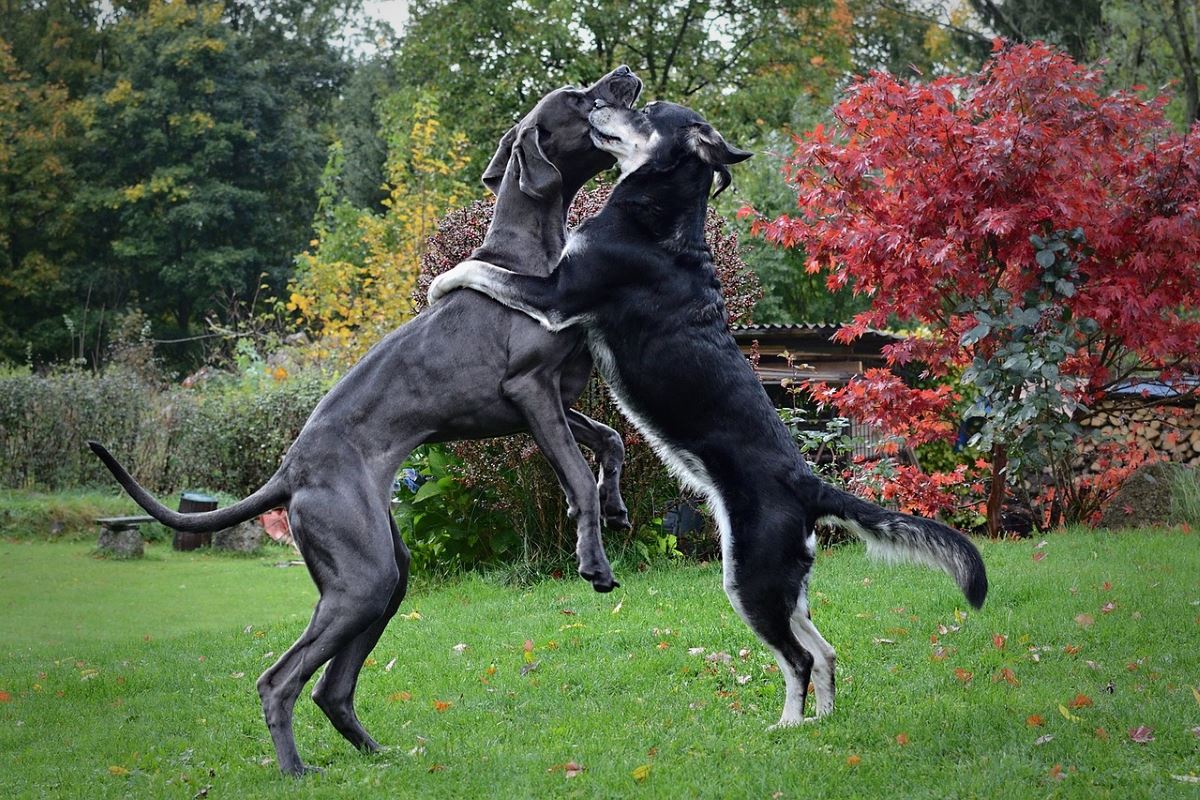
A cuddle is not the same as mounting
When one dog climbs onto another, the gesture should not be automatically read as affection, dominance, or sexual behavior. Excitement, the situation, and the other dog’s reaction all matter. A dog that tries to leave should not be forced to tolerate it.
Interrupt the moment calmly by creating distance and offering a pause, without roughly pulling the dogs apart or trying to press them back together. If the behavior repeats, comes with tension, or is difficult to interrupt, professional help is worthwhile. The goal is to understand what triggers the behavior, not to label the dog.
Should you encourage contact between two new dogs?
Not by placing them in the same bed right away. At the start of a new cohabitation, provide separate resting places, separate meals, and supervised interactions. A relationship is also built through moments when nothing much happens: walking at a distance, exploring separately, and sleeping in the same room without physical contact.
The Dogs Trust advice on introducing a new dog emphasizes a gradual approach that respects the comfort of both animals. A puppy that keeps returning to bother an adult dog needs planned breaks; the adult should not be expected to set every boundary alone.
Avoid videos that bring the dogs’ heads together, hold them tightly, or prevent them from leaving the frame. A better memory is created when the interaction happened naturally, without pressure or staging.
When proximity becomes something to watch
A sudden change deserves attention: a dog that was usually independent now clings constantly to the other, refuses separation, seems painful, or no longer seems able to find a comfortable position. That does not automatically mean there is a relationship problem. Veterinary advice is sensible if the change comes with altered appetite, mobility, sleep, or general behavior.
On the other hand, a dog that once accepted contact may begin avoiding it because of fatigue, age, or physical discomfort. Respect that withdrawal. Do not ask the younger dog to “keep the older one company” by invading the older dog’s rest.
If tension appears near the bed
A growl is a sign to reassess the situation, not to punish the dog for communicating. Calmly reduce pressure, increase the number of resting options, and avoid food or highly valued objects in that area. If conflict becomes serious, do not put your hands between the dogs; create a safe separation and seek professional support.
When choosing that kind of help, it is worth asking practical questions and looking for guidance that is grounded in observation rather than guesswork. A home assessment can be far more useful than drawing conclusions from a photo alone.
A healthy relationship also leaves room
You can enjoy those tender moments without turning them into an expectation. Two dogs that rest separately, play now and then, and know how to avoid one another may still have an extremely comfortable relationship. The best indicator is their ability to choose, relax, and return to calm in everyday life.