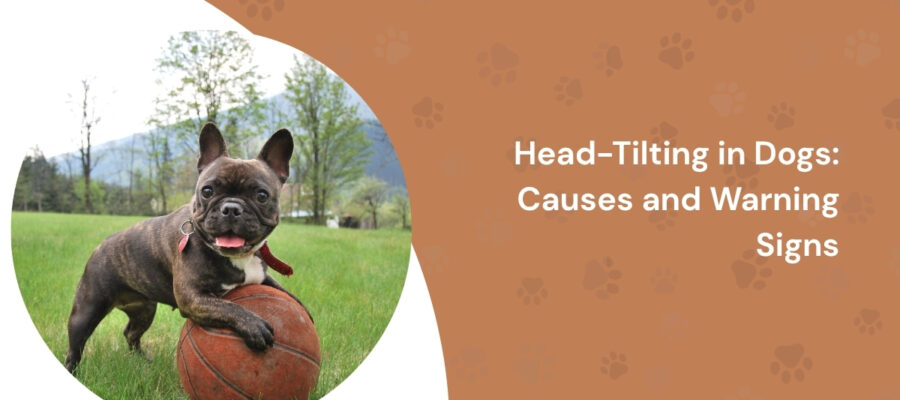
When you say a word and your dog tilts its head, one ear a little higher than the other, it is hard not to smile. The gesture is charming. A brief head tilt during an interaction can signal attention; a head that stays tilted, especially when balance seems off, should be taken seriously.
Before looking for a “hidden meaning,” pay attention to how long it lasts, when it happens, and whether anything else is going on. Those details are what help separate a familiar little habit from a change that deserves an examination.

When a dog listens, what can this movement mean?
Your voice, an unusual sound, or a word linked to a familiar activity can draw a dog’s attention. Tilting the head may be part of how a dog processes something interesting. Several explanations have been suggested, but none can decode every tilt with certainty.
It is tempting to read the gesture as proof that your dog understands every word perfectly. In reality, a dog may be responding to a sound, your tone, a hand movement, or the whole situation at once. The word “walk,” your shoes, and the movement toward the door often arrive together.
So there is no useful dictionary in which a tilt to the right always means happiness and a tilt to the left always means worry. The angle of the head cannot be interpreted on its own, separate from the rest of the body and the context.
What one study actually observed
In an exploratory study on head tilting in dogs, researchers watched dogs during requests to retrieve named toys. Dogs that were especially good at learning object names tilted their heads more often in that situation.
This suggests a possible link with the processing of relevant or familiar information. It does not prove that every dog who tilts its head is more intelligent, or that dogs who do not tilt are less capable of understanding. The experimental setting and the limited number of dogs involved mean the result should be interpreted cautiously.
It is a good reason to find the behavior interesting, not to turn it into an intelligence test at home. A dog’s abilities show up in many other ways, and its comfort matters more than a reaction produced for the camera.
Context tells you more than the angle itself
Ask three simple questions: does the movement appear after a sound? Does it disappear quickly? Is your dog walking and behaving normally otherwise?
| What you see | What you can do |
|---|---|
| A tilt that lasts only a few moments when you speak, then a normal posture returns | Observe without overloading your dog with more prompts. |
| Repeated head shaking, ear scratching, or signs of sensitivity | Arrange a veterinary examination. |
| A head that remains tilted even at rest | Contact a veterinarian promptly, even if your dog is still eating. |
| A sudden tilt with falling, disorientation, or vomiting | Have the situation assessed as an emergency. |
This distinction matters more than breed. Long ears, a particular muzzle shape, or a very expressive face do not rule out pain.
A head that stays tilted is not just a cute habit
A problem affecting the ear, the balance system, or other neurological functions can cause an abnormal posture. The PDSA veterinary guidance on head tilt recommends seeking advice even when no other symptoms are obvious. The look of the movement alone is not enough to identify the cause. An older dog also deserves an examination: “it’s just age” is not a diagnosis.
If your dog is falling or seems disoriented, keep it away from stairs and from furniture it may try to jump onto. Place it somewhere quiet on a non-slip floor and call the vet to arrange transport. Do not try to straighten the head with your hands.
Avoid using leftover ear drops from an old prescription and do not insert cotton swabs deep into the ear. A painful ear should be examined before any product is chosen. If digestive symptoms also appear, describe them precisely; the article on yellow vomiting in dogs outlines signs that warrant a consultation, but it does not replace a proper assessment.
What to note so the vet can help more easily
A short video of your dog at rest and then moving on its own, if it can be done safely, can be useful. Note the time the problem began, which side is tilted, whether it is constant, and any associated symptoms. Mention any bump or fall, a recent ear cleaning, or any ongoing treatment.
Do not trigger several episodes just to get the best angle for filming. If your dog is unwell, care comes before recording. You can simply describe what you saw.
How to communicate with your dog more clearly every day
When everything is fine, speak clearly, use consistent words, and give your dog time to respond. Repeating a command ten times, louder and louder, will not necessarily help it understand. For training a behavior such as lying down, a small predictable gesture and a well-timed reward work better than a long speech.
Also watch the ears, body tension, tail, and whether your dog still wants to continue the interaction. A dog can be attentive without tilting its head. It can also need a break. Respecting both possibilities gives you more useful information than trying to force the cute expression every time.