One dog guides a person through the street, another helps pick up an object, and a third works alongside a professional in a care setting. They may all be useful, but they do not serve the same purpose. The word “therapeutic” is not enough to describe their training, their tasks, or the conditions under which they work.
To understand what a dog can truly contribute to a person who is ill or living with a disability, it is better to start with real needs rather than with the idea of a miracle.
Three situations to distinguish
| Role | What it is meant to provide | What it should not be confused with |
|---|---|---|
| Guide dog | Helping a visually impaired person get around safely | A dog that independently chooses every destination |
| Assistance dog | Carrying out tasks adapted to one person and their needs | A pet that is simply very attached to its owner |
| Dog involved in mediation work | Taking part in a structured project led by professionals | An improvised visit that is supposed to help everyone in the same way |
Terminology can vary from one organisation to another. It is always worth asking what is done, by whom, for whom, and with what kind of assessment. A reassuring label is never a substitute for a clear description.
Guidance is a skill and a partnership
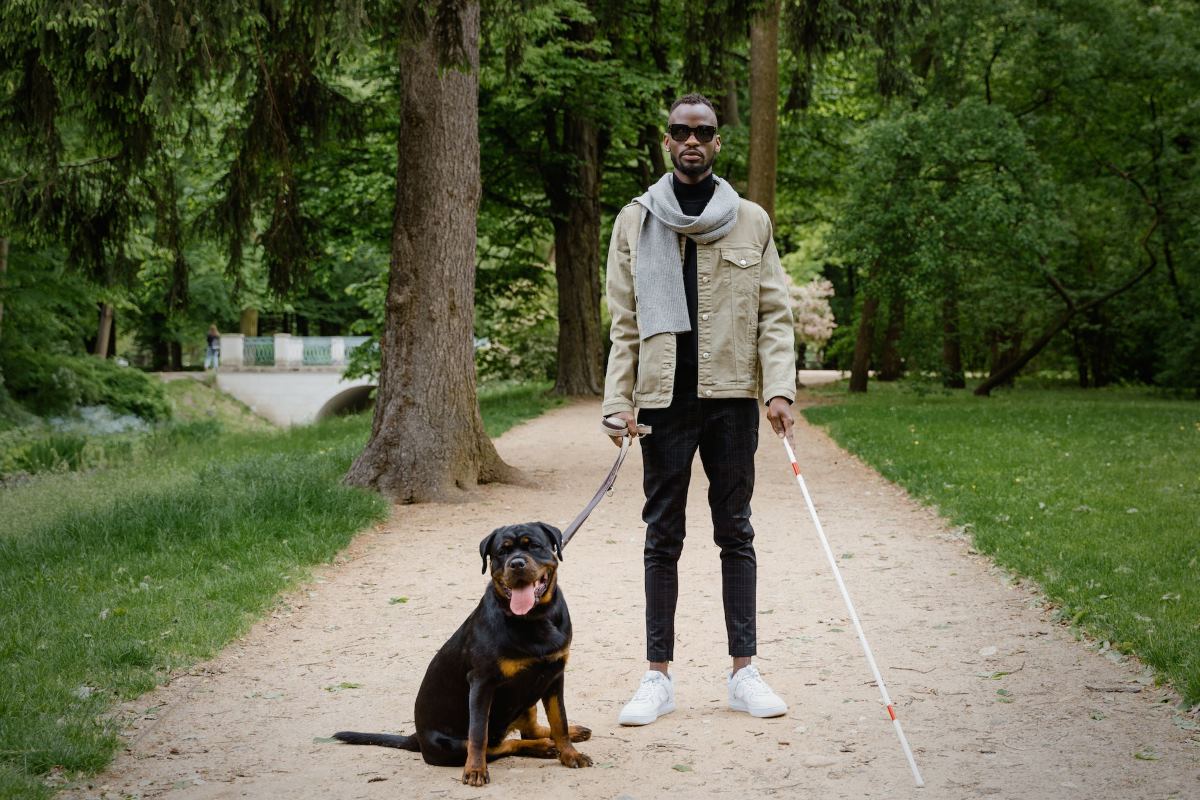
A guide dog learns, among other things, how to avoid obstacles and how to respond to directional cues. The French Federation of Guide Dog Associations explains this training, including the ability to refuse to move forward in dangerous situations.
That does not mean the dog can read signs, understand a new city by instinct, or relieve its human partner of every responsibility for getting around. The two must learn to work as a team. The quality of the partnership matters just as much as the dog’s training.
If you want to help someone in the street, speak to the person directly. Do not grab their arm or their harness without permission, and do not pull the dog in the direction you think is correct.
Assistance responds to specific tasks
Depending on the programme, a dog may fetch objects, help with certain everyday actions, or contribute to an alert system. HANDI’CHIENS describes several assistance missions, both individual and collective.
For epilepsy, the association has a dedicated process for reviewing requests and providing training. That does not mean any dog can be assigned a guaranteed detection rate, or that every seizure will be announced after the same amount of time.
An assistance dog supports an existing care and daily-life organisation. It does not replace treatment, medical follow-up, or any other safety measures planned for the person.
In institutions, the framework makes all the difference
Any animal-led intervention must take consent, fears, allergies, hygiene, and the team’s goals into account. Some people welcome the dog’s presence; others prefer not to take part. Neither response should be forced.
Ask how sessions are prepared, who remains responsible for the dog, and how the handler knows when to stop. A well-run activity also includes breaks for the animal and the option to withdraw it if needed.
A dog is not a tool that can be used without limits. It still needs sleep, care, walks, and ordinary daily activity, even when its presence is deeply beneficial to people.
If you are considering a request, where should you begin?
- Describe the everyday difficulties you face and the tasks where support would be useful.
- Talk with the professionals who already support you.
- Contact an organisation specialised in the type of need involved.
- Ask about eligibility criteria, the steps involved, follow-up, and the beneficiary’s responsibilities.
- Plan for care, routine expenses, and backup arrangements in case of absence.
Waiting times and eligibility criteria vary from one programme to another, so it is better to ask for a direct answer than to rely on a general figure. A serious organisation can also explain when a dog is not suitable for the situation being considered.
When you meet one, let it do its job
Do not call to the dog, offer it food, or bring your own dog close without first speaking to the handler. Even a friendly gesture can distract the animal at the wrong moment.
If a child is present, explain simply that permission must be requested before any contact. Discovery of animals can still happen in other ways, for example through a supervised observation activity. Sometimes respecting distance is the most helpful way to show affection for dogs.