Your dog may sit perfectly in the kitchen and then seem to forget everything at the park. That does not necessarily mean the dog is being stubborn. Training only really sticks when it is practised in different settings, because a behaviour learned in one place does not automatically transfer everywhere else. An effective method makes the desired behaviour easy to understand and worth repeating.
Rather than getting caught up in competing training labels, it is more useful to focus on a concrete goal: coming back when called, settling on a mat, or walking a few steps without pulling. Once the objective is clear, it becomes easier to choose the right tools, reduce frustration, and build a routine that works for both dog and handler.
Rewarding the behaviour: choose what matters to this dog
A small treat, a quick game, or the chance to go sniffing can all be effective rewards, depending on the dog and the situation. What works in a quiet living room may lose all value when a bicycle, another dog, or an unfamiliar sound is suddenly more interesting. In those moments, the answer is often not to insist harder, but to make the exercise easier first.
The AVSAB supports reward-based training. Clear instructions do not require shouting or jerking the leash. What matters far more is consistency: rewarding at the right moment, every time, so the dog can connect the action with the consequence.
Three tools, three uses
Luring to start a movement
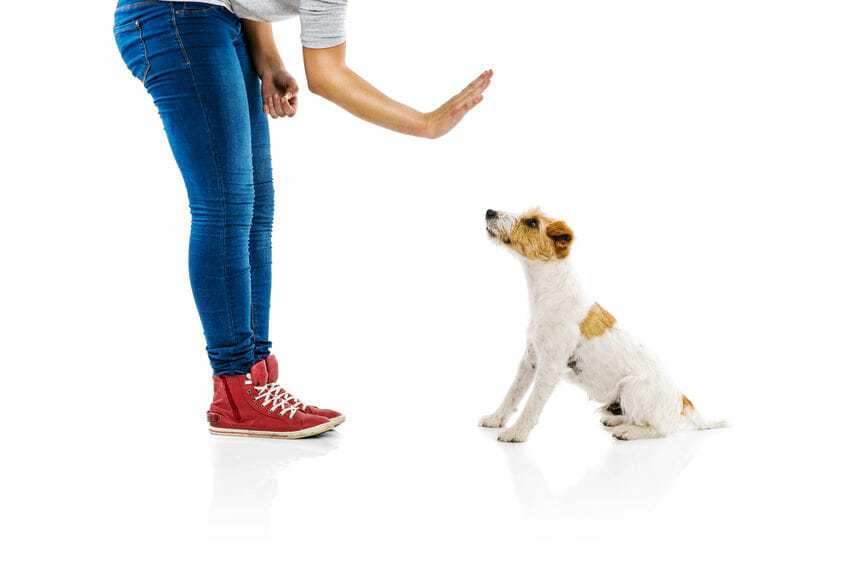
A lure guides the dog into a position without physically pushing or forcing it. If you want the dog to go to a mat, you can lead it with a treat, reward once it steps onto the mat, and then gradually make the hand movement smaller. Over time, the visible food should fade out, otherwise the dog may simply wait for the treat to appear before doing anything.
Capturing what the dog already does
Capture means waiting for a behaviour the dog offers on its own, such as looking at you or lying down calmly, and then rewarding it. This approach is especially useful for house manners and everyday routines. It helps to keep a few rewards within reach of the human, but out of the dog’s reach, so the right moment is not missed.
Using a clicker to mark the exact moment
The click does not replace the reward; it simply tells the dog that a reward is coming. Start by pairing the sound with something pleasant, then use it at the precise instant the desired behaviour happens. A short verbal marker can do the same job. If the sound startles your dog, a softer signal is a better choice.
Choosing a clicker that is easy to use, without piling on gadgets
A clicker is meant to mark a precise moment; it is not a command that tells the dog to come, sit, or be quiet. A consistent word can serve the same purpose if you use it in the same way every time. The accessory is only useful if its sound helps you stay consistent and if your dog accepts it comfortably.
Ergonomics matter more than novelty. Look for something you can press with one hand, hold securely, and keep close without digging through a pocket. A device that combines a whistle, a light, and several functions is not automatically better for training. For noise-sensitive dogs, a soft vocal marker may be the most practical option.
Before asking for an exercise
In a quiet place, pair the click with a small reward, and avoid clicking too close to the dog’s ears. Do a few repetitions, then pause. After that, mark a simple behaviour as it happens and deliver the reward. If you click by mistake, still follow through with the reward; you can improve the timing on the next repetition.
Try not to click repeatedly just to get the dog’s attention. If you do, the signal loses its usefulness. A short session with one clear goal works much better, whether that goal is a glance in your direction or a nose touch to a target. The three models below are simply tools to compare. The quality of learning depends above all on how clear the request is, how difficult the exercise is, and when the reward arrives.
Affiliate links: AnimauxFun may receive a commission on eligible purchases, at no extra cost to you. Products are offered on Amazon; check their features and instructions before choosing.
A session that makes the dog want to do it again
- Choose one objective and an easy setting.
- Ask for a step the dog can succeed at, then reward immediately.
- Repeat a few times, then allow a pause or a moment of freedom.
- Increase only one difficulty at a time: duration, distance, or distractions.
- Go back to something easier if mistakes start to multiply.
For recall, begin just a few steps away in a secure space. Call once, reward the return, and then often let the dog go back to exploring. If every recall ends the fun, coming back quickly becomes less appealing. Outside, keep the dog on a leash or long line until safety is reliable.
Why is it not working yet?
Check the timing, the difficulty, and the motivation. Repeating the same word five times can teach the dog to wait for the fifth repetition. Rewarding only after the dog has already stood up may reinforce something other than the requested lie-down.
If a dog stops eating, freezes, or tries to get away, it does not need a more insistent session. Pause and check whether the dog is comfortable. For two common training issues, look at how to teach a dog to leave the sofa and how to make walks calmer again.
Choosing help without miracle claims
Ask a professional how they respond when a dog makes a mistake, which tools they use, and how they adapt exercises when fear or pain is involved. You can also contact a dog boarding facility in Rennes to ask what services are available, then check whether the approach matches what you want for your dog. A link to a business is not an endorsement of its methods.
If there are bites, significant fear, or a sudden change in behaviour, start with a veterinarian. For ordinary training, keep the goal modest and repeat it in different situations. That is how a success in the kitchen becomes a useful habit outdoors.