
Essentials
- So-called “ugly” dog breeds are usually defined by their unusual looks, but they are often affectionate, loyal, and highly endearing companions.
- The World’s Ugliest Dog contest has been won in recent years by Quasi Modo in 2015, Wild Thang in 2024, and Pétunia in 2025.
- Among the breeds with the most distinctive looks are the Xoloitzcuintle, Chihuahua, Chinese Crested, Pug, French Bulldog, Komondor, Bull Terrier, and Affenpinscher.
Atypical Dog Breeds: Behaviour, Personality, and Lifestyle
Good with children High
Which dog is the ugliest in the world?
Over the years, several dogs with strikingly unusual looks have won this famous competition. Three winners in particular have left a lasting impression.
Quasi Modo, the world’s ugliest “baboon dog” in 2015
In 2015, Quasi Modo was crowned the world’s ugliest dog at a contest held in Petaluma, in the United States. This female dog was born with a very rare condition known as baboon dog syndrome. Her appearance resembles that of a baboon because her spine is unusually short.
Quasi Modo had already entered the contest before and had come in second. With this win, the 10-year-old dog earned her owners, Virginia Sayre, a veterinarian, and her partner Mike Carroll, $1,500. She is a delightful animal who loves walks and being petted. She gets along well with everyone and is very easy to live with.
Wild Thang, the Pekingese who won in 2024
Wild Thang was named the world’s ugliest dog in 2024.
He is an 8-year-old Pekingese. When he was a puppy, he suffered from a serious illness. Sadly, his teeth never grew in, which means his tongue hangs out constantly. Another unusual physical trait is that his left front leg is always in motion.
His appearance is certainly striking. His owner has never had him groomed so that he keeps his natural look. His impressive coat is remarkable, as is his personality. She describes him as a very pleasant companion who especially loves cuddles.
Did you know that if your dog gets sick, dog health insurance can help cover veterinary costs up to 100% depending on the plan you choose, even if your dog has an unusual appearance? It is worth looking into.
Pétunia, the ugliest dog of 2025
At a competition held on 8 August 2025, Pétunia, a small 2-year-old French Bulldog, was named the ugliest dog in the world. She has the unusual feature of having no hair on her body, which is highly uncommon for her breed. Pétunia’s owners won the top prize: a $5,000 cheque.
This competition takes place every year in the United States at the Sonoma-Marin Fair. Its aim is to celebrate imperfection and spotlight dogs that stand out from the crowd.
The contest is also an argument for adoption. Even dogs that are different, or without pedigrees, can become wonderful companions. Never judge by appearance alone.
Which breeds have the most unusual looks?
Some breeds stand out because of physical traits that are impossible to miss. Here are a few dogs whose appearance is especially distinctive:
The Xoloitzcuintle
The Xoloitzcuintle is a very ancient primitive-type breed from Mexico. In pre-Hispanic times, its meat was eaten during certain ritual ceremonies and considered a special delicacy. The dog was also associated with Xolotl*, an Aztec deity from which its name is thought to derive. This special role in belief systems gave it an important place in Mexican culture.
It was also believed to have protective and healing powers. Its warm skin was especially valued as a natural source of heat.
The Mexican Hairless Dog exists in two coat types:
- a hairless variety;
- a variety with a short, dense coat.
The breed also comes in three sizes: miniature, intermediate, and standard.
In all cases, its body is muscular and well balanced, with a long, slender tail. In hairless dogs, the skin may appear in different colours and may sometimes have lighter markings. Coated Xoloitzcuintles, on the other hand, have a short, dense coat.
The Xoloitzcuintle’s skin needs special care. Good hygiene and appropriate grooming help keep it comfortable and prevent dryness.
Santévet advice: sunscreen is strongly recommended in summer to help prevent sunburn. Even with a light coat, this breed remains very sensitive when it comes to skin health.
The Xoloitzcuintle is a calm little companion that can live happily in an apartment or a house with a small garden. A few daily walks are enough to keep it content. On average, it lives between 14 and 16 years.
The Chihuahua
The Chihuahua is the smallest breed in the world. It takes its name from the largest state in the Mexican Republic. It is believed to have come from a cross between the Mexican Hairless Dog and the Techichi. The breed has been officially recognised by the FCI since 1959 and is especially common in the United States.
Males and females are similar in size and weight: between 1 and 3 kg and between 16 and 21 cm at the withers. Its coat may be short and smooth against the body, or long, fine, and slightly wavy. Any coat colour is possible except merle.
Long-haired Chihuahuas should be brushed regularly to prevent tangles. They can be bathed every two to three months with a suitable shampoo.
These are intelligent animals that need firm but gentle training. Their strong personality must be guided so they remain sociable. They are an excellent fit for families living in apartments. A few daily walks will give them exercise and help them burn off energy.
This breed can live for up to 20 years. However, it is relatively delicate around the eyes and prone to patellar luxation.
| According to the August 2014 patellar luxation fact sheet from the Centre Hospitalier Universitaire Vétérinaire de Montréal, “patellar luxation is one of the most common orthopaedic conditions in dogs, diagnosed in 7% of puppies. The condition mainly affects small dogs, particularly breeds such as Boston and Yorkshire Terriers, Chihuahuas.” |
The Chinese Crested Dog
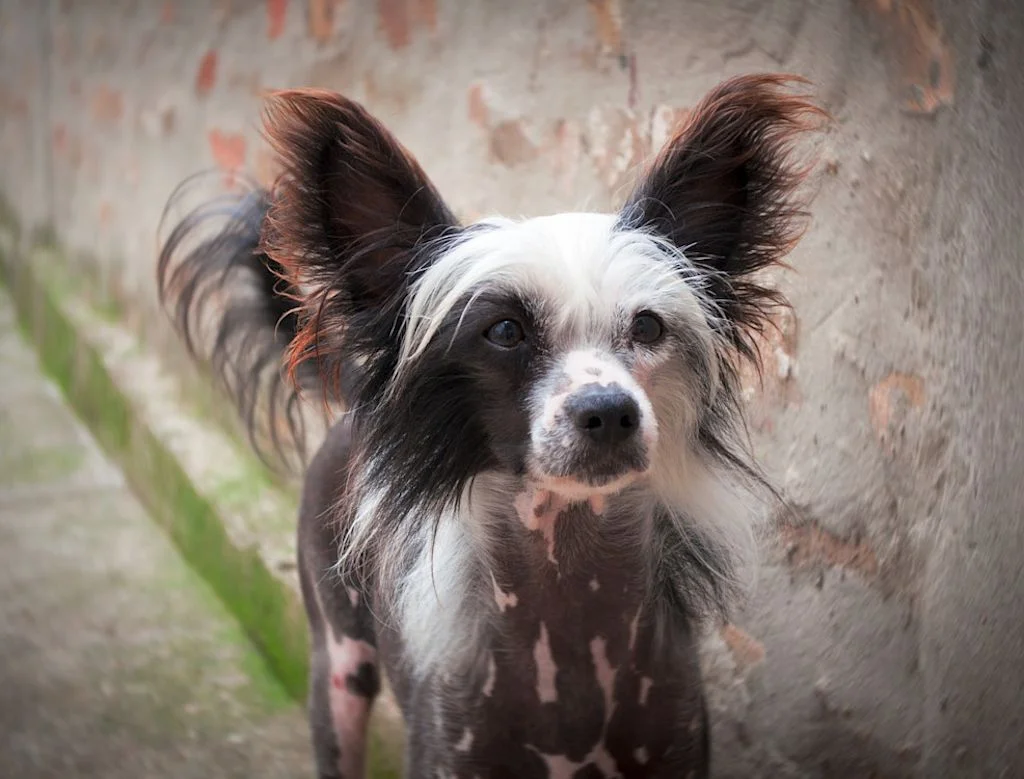
The Chinese Crested Dog is sometimes described as a little ugly dog because it is hairless over most of its body. Only the head, the lower parts of the legs, and the tail are covered in hair. Its appearance is far from ordinary.
Some of its ancestors were used to protect valuable belongings, while others specialised in catching rats on ships. The breed has been recognised by the Fédération Cynologique Internationale since 1972.
These Chinese dogs are gentle and active. They get along well with children and enjoy playing and exercising with them. They are well suited to apartment living, but they remain vulnerable to the elements. They may need a coat in winter and sunscreen in summer.
Because their bodies are largely hairless, they can be prone to certain skin conditions, such as allergic or atopic dermatitis, solar dermatitis, and sunburn.
The Pug
The Pug originates from Asia, although its ancestors can also be traced to Germany, Portugal, or the United Kingdom. The Fédération Cynologique Internationale officially recognised it as a breed in 1966.
This small mastiff-type dog has an unusual build with a compact, muscular body. It may be black, apricot, or silver in colour. Its face is especially flat and marked with wrinkles, which need particular care. After a bath, after rain, or if its eyes water, the folds should be dried thoroughly. Saline solution can also be used.
The Pug, considered by some to be a little ugly dog, has a big heart. It gets on well with everyone, including other animals. It is very cheerful and loves clowning around. It is also suitable for older people because it does not need much exercise. That said, regular walks are still important to prevent weight gain.
In good living conditions, this playful little dog can live up to 15 years.
The French Bulldog
The French Bulldog stands out because of its flat face, typical of brachycephalic breeds. This small mastiff-type dog has a compact, muscular build and a broad, square head with symmetrical folds and wrinkles that give it a very distinctive expression. Its upright bat-like ears and large round eyes also add to its charm.
This unusual structure, although appealing, is not without consequences. Its short muzzle can lead to breathing difficulties, especially in hot weather or during intense physical activity. Its stocky body, supported by short, strong legs, makes it instantly recognisable. Its naturally short tail completes the silhouette.
The French Bulldog weighs between 8 and 14 kg depending on sex, and stands about 30 cm at the withers. Its short, smooth coat may be fawn, brindle, or white. Despite its small-mastiff appearance, it is a gentle and affectionate dog that adapts very well to apartment life, though it requires particular care because it is sensitive to extreme temperatures.
The Komondor
The Komondor is a Hungarian sheepdog that stands out above all for its very unusual appearance.
Physically, it is a large and powerful animal, recognisable by its unique white coat, made up of long cords that resemble dreadlocks. This distinctive coat, which can reach the ground, once served as protection against predators and bad weather while also helping it blend in with the sheep it guarded.
Originally from Hungary, this ancient breed accompanied the Magyar nomads, who introduced it to the country in the 9th century. The Komondor was mainly used to protect flocks of sheep from wolves and bears in the Carpathians. The breed was officially recognised by the FCI in 1954, although it remains rare worldwide.
In terms of temperament and care, the Komondor is calm, independent, and strongly protective. Its coat requires specific maintenance: the cords must be separated regularly by hand to prevent tangling. Bathing is needed only once or twice a year, because drying this impressive coat takes a very long time.
The Bull Terrier
The Bull Terrier comes from a cross between the English Bulldog and the White English Terrier, carried out in the 18th century. The breed was created for fighting against bears, bulls, horses, and even wolves. Fortunately, these practices were banned in the 19th century, and the breed was no longer selected for aggression.
It was later developed into a companion dog. Its egg-shaped head, which is now one of its defining features, was preserved. Its profile is highly recognisable and gives the Bull Terrier a truly unusual look.
These dogs are very affectionate and enjoy human company, though sometimes less so that of other dogs. They like spending time with their owners and going on long walks. It is essential to get them used to being alone gradually, as they may become destructive out of boredom or develop separation anxiety.
The Affenpinscher
The Affenpinscher, whose name means “monkey terrier” in German, is a breed from Germany dating back to the 17th century. Initially bred as a ratter in kitchens and stables, this small dog with an unusual appearance gradually became a beloved companion of the German bourgeoisie. The Fédération Cynologique Internationale officially recognised the breed in 1936.
The Affenpinscher has a lively and determined character, typical of terriers. Despite its small size, it shows a strong temperament and is not afraid to stand up to larger dogs. Intelligent and playful, it becomes deeply attached to its family while still keeping a degree of independence. Its alert nature makes it a delightful companion, provided it receives firm and consistent training.
Its appearance is especially distinctive:
- A round head with a short, flattened muzzle, resembling that of a small monkey, which explains its nickname.
- A coarse, dense coat that forms a kind of mane around the head and emphasises its unusual expression.
- A height of about 25 to 30 cm at the withers and a weight of 4 to 6 kg.
- A coat usually black, but sometimes grey or brown.
What veterinary costs should you expect for a dog with an unusual appearance?
Veterinary expenses for a dog with an atypical look can vary depending on the breed and any underlying fragilities. Some breeds may require more dermatological or respiratory care than others.
| Type of veterinary care | Indicative price |
|---|---|
| Standard consultation | €30 to €50 |
| Vaccination | €50 to €80 |
| Emergency consultation | €80 to €150 |
| X-ray | €50 to €150 |
| Blood test | €50 to €100 |
| Surgery | €500 to several thousand euros |
These prices are indicative and may vary according to the veterinarian, the region, and the type of care required.
Need to talk about your pet’s health? Discover our animal health insurance offer to request a callback from one of our advisors.
Caring for a dog with an unusual body type depends first and foremost on its morphology. Some breeds need special care to protect their skin, coat, or facial folds. Here are the main habits to adopt:
- Care for the skin of hairless dogs: breeds such as the Xoloitzcuintle and the Chinese Crested need special attention. Their skin should be cleaned and moisturised with suitable products. Sunscreen may also be necessary during summer outings to reduce the risk of sunburn.
- Maintain the Komondor’s cords: its corded coat requires specific care. The cords must be separated by hand on a regular basis to prevent tangling and reduce the risk of skin irritation.
- Clean the folds of brachycephalic breeds: the Pug and the French Bulldog have many facial folds that can trap moisture and dirt. They should be cleaned regularly with a soft cloth and dried carefully to reduce the risk of irritation or infection.
What diet is best for a dog with an atypical appearance?
A dog with an unusual appearance does not necessarily need a special diet. As with any dog, food should be adapted to age, size, weight, and activity level. Some breeds may be more prone to weight gain or have specific needs because of their build. A balanced diet, given in the right quantity, helps maintain good health and condition.
Here is an approximate budget:
| Type of food | Average monthly budget |
|---|---|
| Dry food | €20 to €60 |
| Wet food | €30 to €80 |
| Mixed feeding | €30 to €90 |
| Home-prepared diet | €50 to €100 or more |
These prices are provided for guidance only. The budget depends in particular on the dog’s weight, the amount needed, and the quality of the food chosen.
How much does a dog with an unusual appearance cost?
| Breed | Minimum price | Maximum price |
|---|---|---|
| The Xoloitzcuintle | €1,000 | €1,500 |
| The Chihuahua | €1,500 | €2,500 |
| The Chinese Crested Dog | €700 | €1,200 |
| The Pug | €1,100 | €1,600 |
| The French Bulldog | €1,000 | €1,500 |
| The Komondor | €1,200 | €2,000 |
| The Bull Terrier | €1,000 | €1,500 |
| The Affenpinscher | €800 | €1,200 |
No dog can truly be considered ugly. A dog may simply look different or have a particularly unusual coat, but most of them are wonderful companions with big hearts. Their loyalty is legendary, as is their unconditional love. Like people, they should not be judged by appearances alone.
Source: *National Institute of Anthropology and History of Mexico
Santévet
Leader in animal health insurance
Photos: 123 rf