A small, moist mass or a pink tubular piece of tissue appearing at your dog’s anus is alarming, and it should be treated as a veterinary emergency. This kind of tissue may be a rectal prolapse and needs urgent veterinary attention. Do not wait for it to turn dark or for your dog to become obviously ill. Call the clinic right away and describe exactly what you can see.
Why you should not wait
With a prolapse, part of the rectum protrudes through the anus. Once exposed, that tissue can swell, dry out, and become damaged very quickly. The Merck Veterinary Manual describes the need for rapid correction and for investigating the underlying cause of the straining.
A pink color does not mean the situation can safely wait for days. Darkening tissue, marked pain, bleeding, or lethargy make the situation even more urgent. Even if the mass seems to go back in between bowel movements, the dog still needs an examination because the problem can recur.
What to do before and during transport
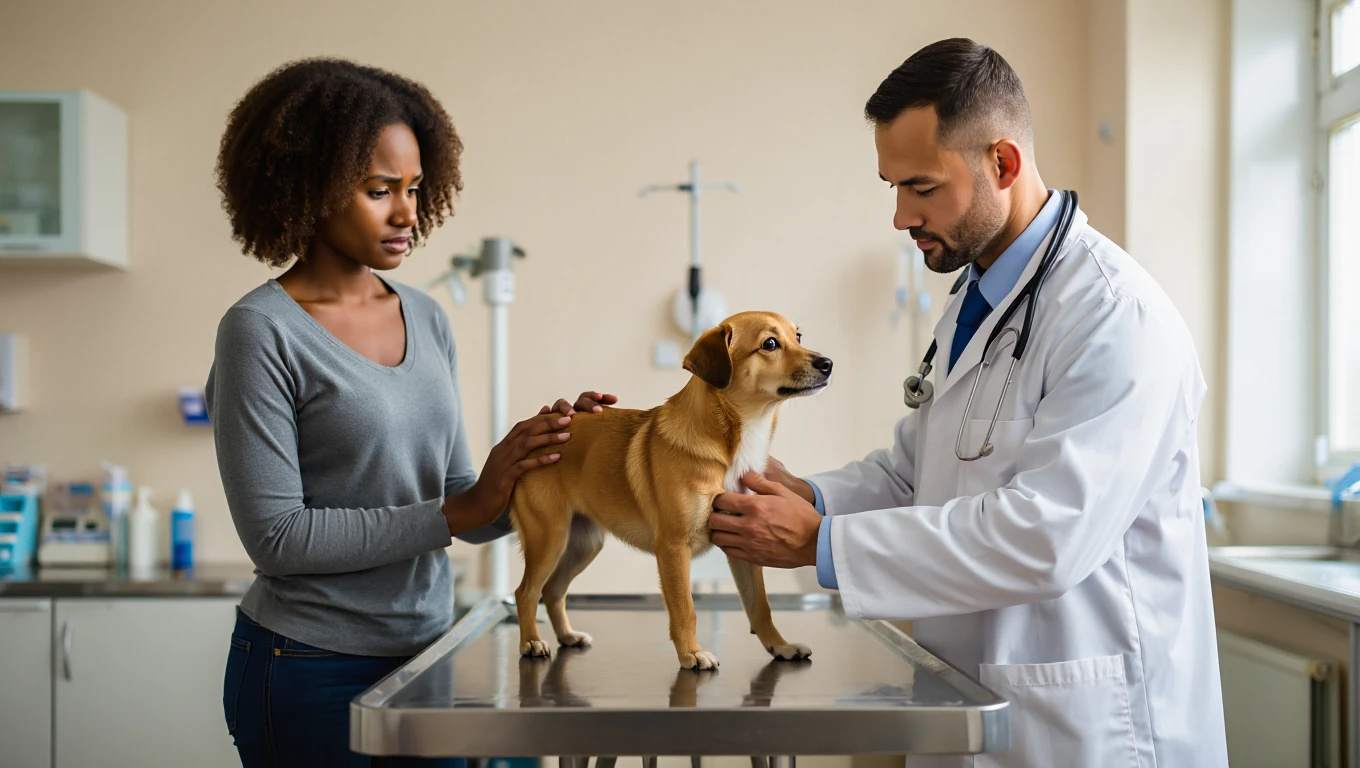
- Call the veterinarian or emergency clinic, and send a photo if requested.
- Prevent licking and rubbing as much as possible, but do not press on the area.
- Ask how to protect the tissue during transport; the clinic may advise gentle coverage moistened with saline solution.
- Keep your dog calm and limit handling to what is strictly necessary.
Do not try to push the tissue back in with your fingers. Do not apply human creams, irritating disinfectants, ice, or home remedies involving sugar. Some techniques are used in veterinary medicine, but they require an examination and appropriate conditions. The fact that a method appears in a medical reference does not make it safe to attempt at home.
If your dog may bite because of pain, do not wrestle with him to get a better look. Explain the problem clearly on the phone so the clinic can help you plan a safe transport. You should also ask whether food should be withheld before arrival, since sedation or anesthesia may be needed.
Rectal prolapse or another problem near the anus?
Swelling beside the anus, an abscess, a mass, or another condition can look similar at first glance. There is no need to try to distinguish among these possibilities by inserting an object or palpating the area. Simply note where the tissue appears, when it first showed up, and what happened just before it was noticed.
Difficulty urinating is an especially important detail. A dog that is straining is not necessarily trying to defecate: a urinary obstruction can also cause repeated pushing and is also an emergency. Tell the clinic whether the dog is actually passing urine, rather than only describing how many times he has assumed a posture to strain.
Why this can happen
Repeated straining caused by diarrhea, constipation, parasites, or a digestive disorder may play a role. Urinary or reproductive problems can also be contributing factors. This issue is not limited to one breed, and it does not automatically mean the dog has worms.
Be ready to tell the veterinarian about the dog’s stool history, parasite prevention, medications, and any recent changes in diet. Also mention vomiting and any loss of appetite. Do not give an extra laxative or dewormer in an attempt to solve the problem before the examination.
How the veterinarian treats it
Treatment depends on the condition of the tissue and on the underlying cause. If the tissue is still viable, it may sometimes be placed back in position and measures may be taken to help prevent it from coming out again. More severe damage or a recurrence may require surgery. Anesthesia, medication, and aftercare are chosen according to the case; there is no single home protocol that applies to every dog.
Ask what was done, when the follow-up visit is planned, and whether a stitch will need to be removed. Treating the cause of the straining is just as important as correcting the visible prolapse.
What to watch for after returning home
Follow the instructions for the collar, activity, food, and medication. Keep track of bowel movements, urination, and any unusual straining. A new protrusion, increasing pain, lack of urination, or a worsening general condition means you should call back quickly.
Do not add fiber automatically: depending on the cause and treatment, the diet may need to be adjusted in a different way. Keep written instructions available to everyone caring for the dog. If prescribed items need to be purchased, a veterinary pharmacy guide can help avoid improvised substitutions.